
Pupil Labs - Neon
High Level Neon Introduction
Neon is a calibration-free, wearable eye tracker. The system consists of two inward-facing eye cameras and one forward-facing world camera mounted on a wearable eyeglasses-like frame.
Neon provides gaze data in its world camera’s field of view, regardless of the wearer’s head position. As such, gaze can be analysed with the wearer looking and moving freely in their environment.
Neon is unlike remote eye trackers which employ cameras mounted on or near a computer monitor. They provide gaze in screen-based coordinates, and this facilitates closed-loop analyses of gaze based on the known position of stimuli on-screen and eye gaze direction.
To use Neon for screen-based work in |PsychoPy|, the screen needs to be robustly located within the world camera’s field of view, and Neon’s gaze data subsequently transformed from world camera-based coordinates to screen-based coordinates. This is achieved with the use of AprilTag Markers.
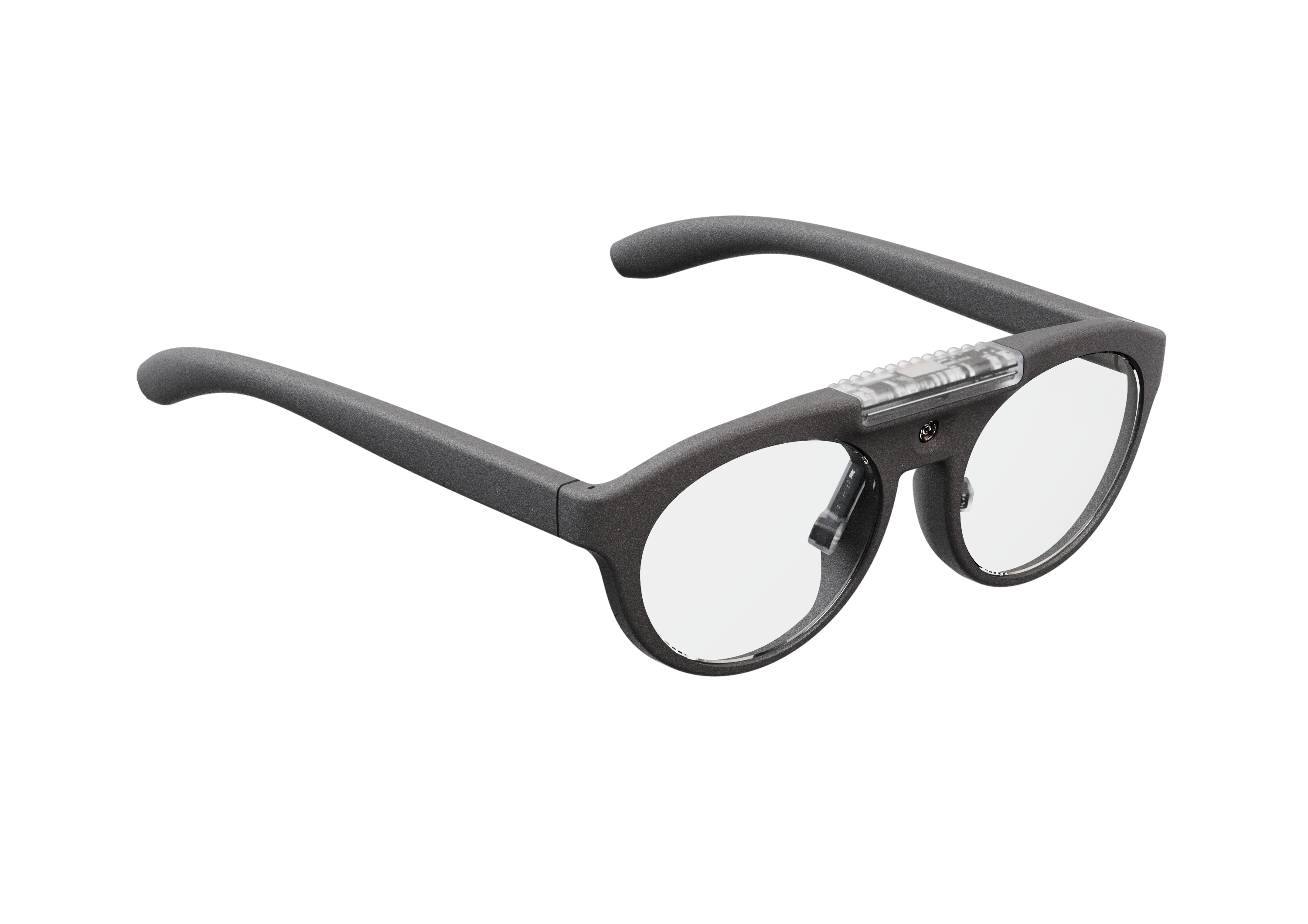
For a detailed overview of wearable vs remote eye trackers, check out this Pupil Labs blog post.
Join the Pupil Labs Discord community to share your research and/or questions.
Device, Software, and Connection Setup
Setting Up the Eye Tracker
Follow Neon’s Getting Started guide to setup the headset and companion device.
Setting Up |PsychoPy|
Install the
Pupil Labsplugin using the Plugin Manager and restart Builder.Open
experiment settingsin the Builder Window (cog icon in top panel)Open the
EyetrackingtabModify the properties as follows:
Select
Pupil Labs (Neon)from theEyetracker Devicedrop down menuCompanion address/Companion port- Defines how to connect to the Companion Device. These values can be found in the Neon Companion app by clicking theStreambutton in the top-left corner of the app.
Add AprilTag components to the routines that require eyetracking. - The
April Tag Framecomponent provides an easy way to add an array of AprilTag markers around the edges of the display. - If theApril Tag Frameis not workable (for example, you need to render a stimulus in the corner of the display), advanced marker placement is possible using individualApril Tagcomponents.Three markers is generally considered a bare minimum, but more markers will yield more robust detection and more accurate mapping.
All markers which are displayed simultaneously must each use a unique marker ID.
Markers can be placed anywhere on the screen as long as they are fully visible and do not overlap.
A sample experiment is available for reference.
Implementation and API Overview
EyeTracker Class
- class psychopy.iohub.devices.eyetracker.hw.pupil_labs.neon.EyeTracker(*args, **kwargs)[source]
Bases:
EyeTrackerDeviceImplementation of the
Common Eye Tracker Interfacefor the Pupil Core headset.Uses ioHub’s polling method to process data from Pupil Capture’s Network API.
To synchronize time between Pupil Capture and PsychoPy, the integration estimates the offset between their clocks and applies it to the incoming data. This step effectively transforms time between the two softwares while taking the transmission delay into account. For details, see this real-time time-sync tutorial.
Note
Only one instance of EyeTracker can be created within an experiment. Attempting to create > 1 instance will raise an exception.
- getLastGazePosition() Tuple[float, float] | None[source]
The getLastGazePosition method returns the most recent eye gaze position received from the Eye Tracker. This is the position on the calibrated 2D surface that the eye tracker is reporting as the current eye position. The units are in the units in use by the ioHub Display device.
If binocular recording is being performed, the average position of both eyes is returned.
If no samples have been received from the eye tracker, or the eye tracker is not currently recording data, None is returned.
- Returns:
- None:
If the eye tracker is not currently recording data or no eye samples have been received.
- tuple:
Latest (gaze_x,gaze_y) position of the eye(s)
- getLastSample() None | psychopy.iohub.devices.eyetracker.MonocularEyeSampleEvent | psychopy.iohub.devices.eyetracker.BinocularEyeSampleEvent[source]
The getLastSample method returns the most recent eye sample received from the Eye Tracker. The Eye Tracker must be in a recording state for a sample event to be returned, otherwise None is returned.
- Returns:
- MonocularEyeSample:
Gaze mapping result
- BinocularEyeSample:
Eye state data
- None:
If the eye tracker is not currently recording data.
- isConnected() bool[source]
isConnected returns whether the ioHub EyeTracker Device is connected to Pupil Capture or not. A Pupil Core headset must be connected and working properly for any of the Common Eye Tracker Interface functionality to work.
- Parameters:
None
- Returns:
bool: True = the eye tracking hardware is connected. False otherwise.
- isRecordingEnabled() bool[source]
The isRecordingEnabled method indicates if the eye tracker device is currently recording data.
- Returns:
True== the device is recording data;False== Recording is not occurring
- setConnectionState(enable: bool) None[source]
setConnectionState either connects (
setConnectionState(True)) or disables (setConnectionState(False)) active communication between the ioHub and Pupil Capture.Note
A connection to the Eye Tracker is automatically established when the ioHub Process is initialized (based on the device settings in the iohub_config.yaml), so there is no need to explicitly call this method in the experiment script.
Note
Connecting an Eye Tracker to the ioHub does not necessarily collect and send eye sample data to the ioHub Process. To start actual data collection, use the Eye Tracker method
setRecordingState(bool)or the ioHub Device method (device type independent)enableEventRecording(bool).- Parameters:
enable (bool) – True = enable the connection, False = disable the connection.
- Returns:
bool: indicates the current connection state to the eye tracking hardware.
- setRecordingState(should_be_recording: bool) bool[source]
The setRecordingState method is used to start or stop the recording and transmission of eye data from the eye tracking device to the ioHub Process.
If the
pupil_capture_recording.enabledruntime setting is set toTrue, a corresponding raw recording within Pupil Capture will be started or stopped.should_be_recordingwill also be passed toEyeTrackerDevice.enableEventReporting().- Parameters:
recording (bool) – if True, the eye tracker will start recordng data.; false = stop recording data.
- Returns:
bool: the current recording state of the eye tracking device
- trackerSec() float[source]
Returns
EyeTracker.trackerTime()- Returns:
The eye tracker hardware’s reported current time in sec.msec-usec format.
- trackerTime() float[source]
Returns the current time reported by the eye tracker device.
Implementation measures the current time in PsychoPy time and applies the estimated clock offset to transform the measurement into tracker time.
- Returns:
The eye tracker hardware’s reported current time.
Supported Event Types
The Neon–|PsychoPy| integration provides real-time access to MonocularEyeSampleEvent events for gaze data.
- class psychopy.iohub.devices.eyetracker.MonocularEyeSampleEvent(*args, **kwargs)[source]
A MonocularEyeSampleEvent represents the eye position and eye attribute data collected from one frame or reading of an eye tracker device that is recoding from only one eye, or is recording from both eyes and averaging the binocular data.
Event Type ID: EventConstants.MONOCULAR_EYE_SAMPLE
Event Type String: ‘MONOCULAR_EYE_SAMPLE’
- device_time: float
time of gaze measurement, in sec.msec format, using Pupil Capture clock
- logged_time: float
time at which the sample was received in PsychoPy, in sec.msec format, using PsychoPy clock
- time: float
time of gaze measurement, in sec.msec format, using PsychoPy clock
- delay: float
The difference between
logged_timeandtime, in sec.msec format
- gaze_x: float
x component of gaze location in display coordinates.
- gaze_y: float
y component of gaze location in display coordinates.
Eye state data, if enabled, is provided through BinocularEyeSampleEvent events.
- class psychopy.iohub.devices.eyetracker.BinocularEyeSampleEvent(*args, **kwargs)[source]
The BinocularEyeSampleEvent event represents the eye position and eye attribute data collected from one frame or reading of an eye tracker device that is recording both eyes of a participant.
Event Type ID: EventConstants.BINOCULAR_EYE_SAMPLE
Event Type String: ‘BINOCULAR_EYE_SAMPLE’
- device_time: float
time of eye state measurement, in sec.msec format, using Pupil Capture clock
- logged_time: float
time at which the sample was received in PsychoPy, in sec.msec format, using PsychoPy clock
- time: float
time of eye state measurement, in sec.msec format, using PsychoPy clock
- delay: float
The difference between
logged_timeandtime, in sec.msec format
- left_eye_cam_x: float
x component of left eye’s position relative to the scene camera
- left_eye_cam_y: float
y component of left eye’s position relative to the scene camera
- left_eye_cam_z: float
z component of left eye’s position relative to the scene camera
- left_gaze_x: float
x component of left eye’s optical axis vector
- left_gaze_y: float
y component of left eye’s optical axis vector
- left_gaze_z: float
z component of left eye’s optical axis vector
- left_pupil_measure1: float
left eye pupil diameter in mm
- right_gaze_x: float
x component of right eye’s optical axis vector
- right_gaze_y: float
y component of right eye’s optical axis vector
- right_gaze_z: float
z component of right eye’s optical axis vector
- right_pupil_measure1: float
right eye pupil diameter in mm
Default Device Settings
Last Updated: October, 2024